
Product Updates: Metaobject Pickers, View Transition API, and more

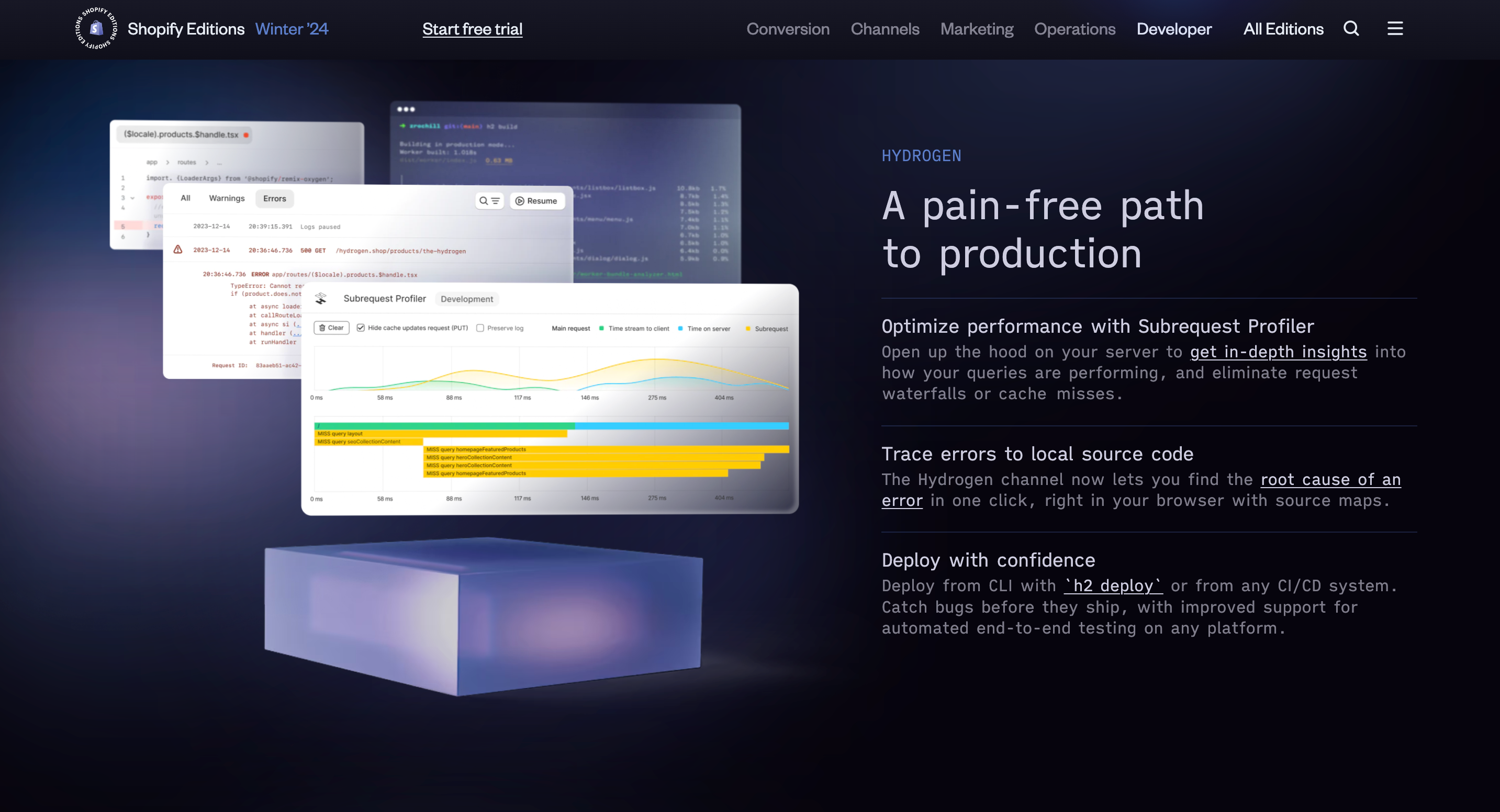
In case you didn't hear: The new Hydrogen updates in Shopify Winter 2024 are amazing. As they put it - a pain-free path to production and it’s no fluff. The latest releases cover a wide range of improvements and updates that vastly improve developer experience with Hydrogen, including:
-
Share storefront previews using tokenized links, accessible to anyone.
-
Easily upgrade your Hydrogen project and stay updated with 'h2 upgrade' from the CLI.
-
Monitor, fix and catch bugs before they ship with a suite of new developer tools.
-
Deploy more flexibly and easily now that Hydrogen's server now mirrors Oxygen's.
-
Manage privacy preference across services with ease as Customer Privacy API is now compatible with Hydrogen storefronts.
And these are not even THE BEST updates yet :) But we’ll get to that later. Let’s get to this month's updates from Weaverse first.
🤖 Criminally smooth View Transition for Pilot Theme
We’ve recently updated our Pilot Shopify Hydrogen theme with View Transition API and the results are impressive! It integrates smoothly into Hydrogen, thanks to the Remix unstable_viewTransition prop.
yes 😄
— tobi lutke (@tobi) January 12, 2024
And when I asked if we should add this as a default feature for the Hydrogen theme, Tobi said yes. You know Tobi, he’s the guy who built Shopify ;)
🖼️ New Shopify Hydrogen Theme for Beauty & Cosmetic brands (Coming soon)
We're kicking off our new Shopify Hydrogen theme - Naturelle - by first building a strong design system and making the most of the React ecosystem's composability. Shadcn UI has been a great resource for our style guide and defining atomic components. Nonetheless, we're tweaking it to better fit eCommerce aesthetics.
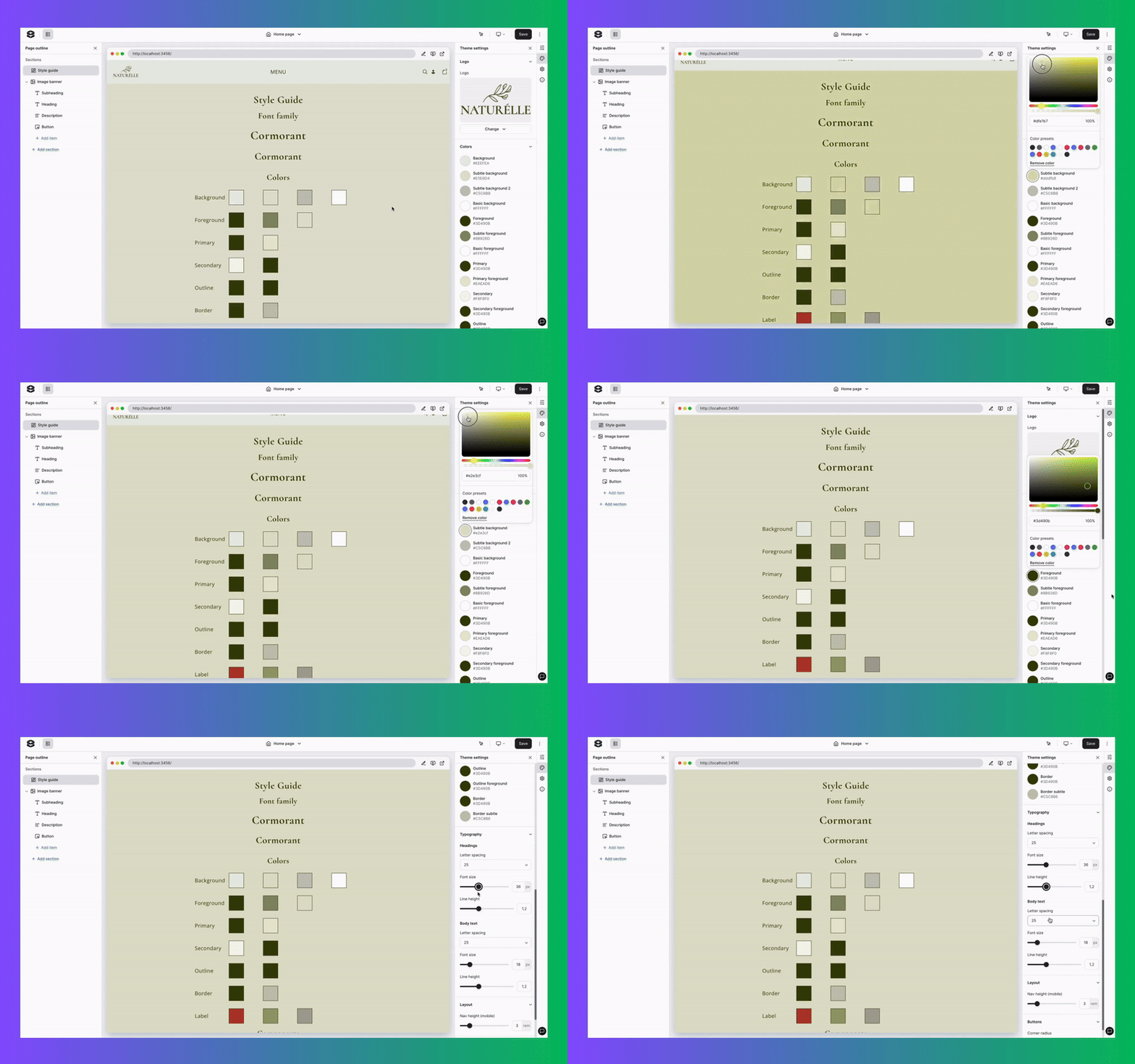
We'd also love to hear your thoughts on the features and functionalities you wish to see in a Beauty/Cosmetic theme. Feel free to let me know, either by replying directly to this email or drop me a note on Linkedin.
🚘 Shopify Object Picker is now available in Weaverse
We've integrated Shopify Metaobject Picker into Weaverse Studio, allowing you to create content components once, and reuse them anytime, anywhere.
With Metaobjects Picker:
-
Developers can define metaobject definitions and quickly customize them into content sections
-
Merchants manage these metaobjects easily via Shopify admin and integrate them on their Hydrogen storefronts with Weaverse.
For the full demo, check out this post.

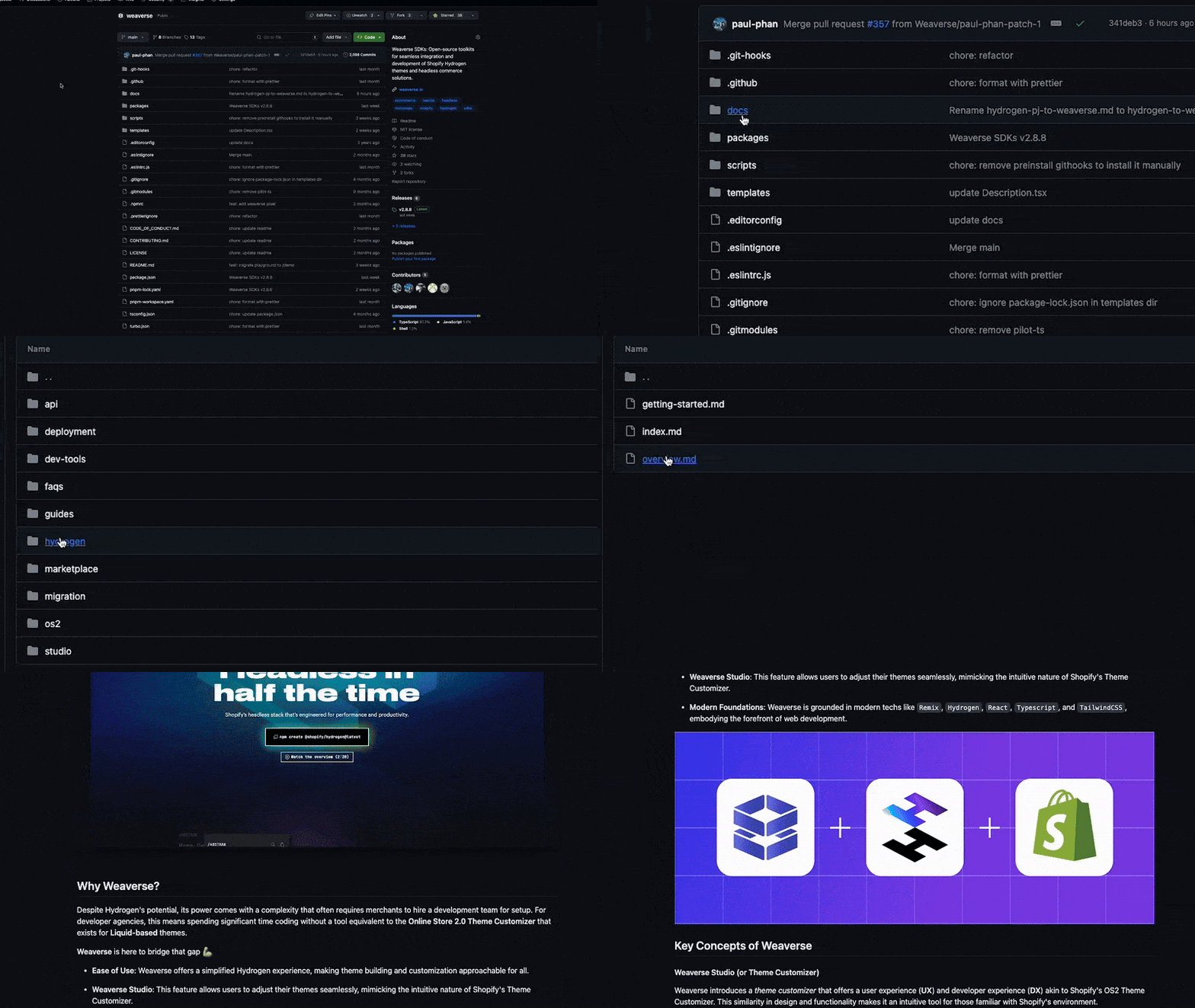
💼 Weaverse docs are now on public GitHub Repo
We've just moved our docs to the public Weaverse repo. Think of it like a headless CMS - we store and update our content there and then pull it into our site via API. Thanks to Remix, @epicweb-dev/cachified and lru-cache, everything loads super fast.
🌊 The best Hydrogen Update
As I say, the best Hydrogen update is not a feature update.
The best update is the case studies.
Last year, and I don’t know if you remember, there were only 03 customer case studies on the Hydrogen site. Even tho they’re neatly written, they’re not entirely convincing. Moving to Hydrogen sounded a bit daunting without proper case studies covering the entire process because no one wants to be the guinea pig.
Maybe that’s why this year they don’t just talk about the features, they talk about what those features can do, using real-life case studies: one focusing on the merchant, the other focusing on the agency.
For Form Factory, the combination of Hydrogen, Metaobjects, and Oxygen provided the ability to wrangle complex data and enabled modern efficient development workflows, all through Shopify’s familiar user interface.
For Nour Hammour, Hydrogen allowed them to translate in-person interactions into the digital space. Their new online storefronts are fast, functional, and immersive through stunning storytelling.
Of course now if you notice, there’s one thing missing, from both the features update and the case studies: End user experience. Editing a Hydrogen storefront visually is still cumbersome, more or less. Most front-end changes still have to go through developers. You can use Sanity, yes, but the editing experience is far from as intuitive as the familiar OS 2.0.
And now there’s a tool for that. :)
Reactions
Join the Discussion
Continue Reading
More insights from the Weaverse team

Shopify Storefront MCP Is Live — What It Means for Headless Commerce in 2026
Shopify Storefront MCP Is Live — What It Means for Headless Commerce in 2026 Shopify just shipped the Hydrogen Winter 2026 Edition, and buried in the release notes is a feature that changes how AI interacts with ecommerce: Storefront MCP. MCP (Model Context Protocol) is the emerging standard for AI agents to interact with external systems. Shopify's implementation means AI assistants can now wire directly into your Hydrogen storefront — query real-time product data, manage carts, guide checkout — all through structured APIs. Here's what's live now: 1. Storefront MCP AI agents built directly into Hydrogen storefronts. Real-time product data, cart management, checkout guidance. This is the infrastructure layer for agentic commerce — not a chatbot widget, but a protocol for AI assistants that shop on behalf of customers. → https://shopify.dev/docs/apps/build/storefront-mcp 2. Shopify Catalog Your headless store becomes discoverable by ChatGPT, Perplexity, and other AI shopping tools. When a customer asks an AI assistant to "find me the best running shoes under $150," your products can be in that answer set. → https://help.shopify.com/en/manual/promoting-marketing/seo/shopify-catalog 3. Dev MCP Cursor, Claude, and other AI coding tools now have native Hydrogen documentation access. Better code suggestions, less hallucination, faster storefront builds. → https://shopify.dev/docs/apps/build/devmcp Why this matters now The "agentic commerce" shift is arriving in March 2026. But the winners won't be brands with the best AI marketing — they'll be brands with storefronts AI can actually interact with. Hydrogen + React Router + Oxygen is purpose-built for this: Structured Storefront API responses AI can parse Edge-deployed sub-1000ms TTFB for AI-referred traffic Full control over JSON-LD and machine-readable markup Liquid themes require HTML parsing, slower response times, and offer limited structured data control. The question for 2026 It's not "do I need headless?" It's "is my storefront AI-ready?" At Weaverse, we've been building for this moment — visual editing for Hydrogen that doesn't sacrifice the developer control you need to wire up Storefront MCP and AI agents properly. The future isn't "website as database." It's structured backend for AI + compelling frontend for humans. Build for both. → https://weaverse.io FAQ What is Storefront MCP? MCP (Model Context Protocol) is a standardized way for AI agents to interact with external systems. Shopify's Storefront MCP lets AI assistants query your Hydrogen store's product data, manage carts, and guide checkout through structured APIs. How is this different from a chatbot? Chatbots are frontend widgets that interact with customers. Storefront MCP is infrastructure — AI agents can interact with your store's data and commerce logic directly, enabling deeper integration with AI shopping assistants like ChatGPT and Perplexity. Do I need to be on Hydrogen to use this? Storefront MCP is designed for Hydrogen and headless storefronts. Liquid themes can benefit from Shopify Catalog (AI discoverability) but lack the structured API access that makes MCP powerful. When is this available? Storefront MCP, Shopify Catalog, and Dev MCP are all live now as part of the Hydrogen Winter 2026 Edition. How do I get started? If you're already on Hydrogen, review your Storefront API implementation and ensure your product data is complete. For teams considering the move, now is the time to evaluate Hydrogen's advantages for the agentic commerce era. Sources Shopify Storefront MCP Documentation Shopify Catalog Help Center Dev MCP Documentation Hydrogen Winter 2026 Update
Why Your Shopify Storefront Needs to Be AI-Ready Right Now
Why Your Shopify Storefront Needs to Be AI-Ready Right Now Breaking: Shopify just emailed merchants that ChatGPT integration is coming "later in March." Buyers will find your products and complete purchases inside ChatGPT. But here's what most people missed: OpenAI simultaneously scaled back Instant Checkout. Purchases now redirect to your storefront. That changes everything. What just happened Two signals, one story: Shopify Agentic Storefronts — confirmed launch in March. Your products become discoverable and purchasable inside ChatGPT. OpenAI's checkout pivot — no more seamless Instant Checkout. AI sends buyers to merchant storefronts to close the deal. Harley Finkelstein called this "the transformation of a lifetime" at Upfront Summit LA on March 16. The implication: AI will drive high-intent traffic to your storefront. Whether you convert them depends on how AI-ready your store is. Why headless wins this shift Here's the technical reality most merchants don't understand: AI agents don't browse like humans. They don't see your beautiful Liquid theme. They parse structured data. When ChatGPT recommends your product and the buyer clicks through, what happens next depends on your architecture: Liquid ThemeHydrogen Headless HTML parsing requiredDirect Storefront API access Slower TTFBEdge-deployed on Oxygen Limited structured dataFull JSON-LD control Customer account frictionNative Customer Account API AI-referred traffic is high intent. These aren't browsers. These are buyers who've already decided. A slow, unoptimized Liquid store wastes that intent. The developer checklist for AI-readiness If you're building on Shopify in 2026, here's what "AI-ready" actually means: 1. Structured product data (metafields) AI agents parse metafields to understand your products. If your specs live only in HTML descriptions, AI can't read them. Action: Move critical product data to metafields. Use standard namespaces (custom.specs, custom.materials, etc.). 2. JSON-LD schema markup Google's crawlers aren't the only consumers of structured data anymore. AI agents rely on schema.org markup to understand your catalog. Action: Implement Product, Offer, and Organization schema. Validate with Google's Rich Results Test. 3. Sub-1000ms TTFB on mobile AI-referred buyers expect instant loads. If your Liquid theme takes 3+ seconds, you've lost them before they see your product. Action: Audit Core Web Vitals. Consider Hydrogen + Oxygen for AI-critical traffic paths. 4. Customer Account API readiness AI-assisted purchases still require authentication. Legacy customer accounts create friction. The new Customer Accounts system is built for this world. Action: Migrate from legacy customer accounts. Enable multipass for seamless AI-to-storefront handoffs. What OpenAI's pullback really means The Instant Checkout retreat isn't a failure. It's a recognition: Merchant storefronts matter. AI can find products. It can compare specs. It can build carts. But the final purchase decision—trust, brand experience, upsells—still happens on your turf. This is good news for serious merchants. It means: You control the conversion experience You own the customer data You can optimize for AI-referred traffic specifically But only if your storefront is built for it. The hidden risk: AI-referred traffic is unforgiving Here's what keeps me up at night: AI-referred buyers have zero patience. They didn't come from Google search, slowly evaluating options. They came from ChatGPT, where an AI already narrowed their choices. By the time they hit your store, they're ready to buy. If your store: Takes 3+ seconds to load Has broken mobile navigation Requires account creation before checkout Can't handle high-intent traffic spikes You don't just lose a sale. You waste the most valuable traffic source emerging in 2026. What to do right now This week: Audit your mobile load speed Check metafield coverage on top 20 products Validate JSON-LD schema This month: Test your Storefront API response times Review Customer Accounts migration status Evaluate Hydrogen for AI-critical paths This quarter: Build AI-readiness into your 2026 roadmap Consider headless for high-intent landing experiences Implement proper analytics for AI-referred traffic attribution The bigger picture Agentic commerce isn't coming. It's here. Shopify's integration with ChatGPT is just the start. Google, Meta, and every major platform are building AI shopping experiences. The question isn't whether AI will drive commerce traffic. It's whether your storefront is ready to receive it. The merchants who win in 2026 won't just have great products. They'll have infrastructure designed for an AI-first shopping journey—structured data, fast APIs, and storefronts that convert high-intent AI referrals. Don't optimize for yesterday's traffic. Build for tomorrow's. Ready to audit your storefront's AI-readiness? Talk to Weaverse. FAQ When does Shopify Agentic Storefronts launch? Shopify emailed merchants it will arrive "later in March 2026." Does this work with Liquid themes? Technically yes, but Liquid themes face structural limitations (parsing requirements, TTFB, structured data control) that Hydrogen headless storefronts don't have. What happened to OpenAI Instant Checkout? OpenAI scaled back the feature. AI-assisted purchases now redirect to merchant storefronts rather than completing inside ChatGPT. Is this only for Shopify Plus? No, Agentic Storefronts will be available to all Shopify merchants, though implementation complexity varies by plan. How do I track AI-referred traffic? Implement UTM parameters and proper attribution. Shopify hasn't released specific AI referral tracking yet, but standard analytics with custom segments can help. Sources TechCrunch: Shopify and OpenAI agentic commerce Modern Retail: Agentic storefronts explained Shopify Changelog: Upcoming features Ringly: Agentic commerce analysis
Shopify’s CEO Used a Coding Agent to Make Liquid 53% Faster — What That Means for Shopify Teams
Shopify’s CEO Used a Coding Agent to Make Liquid 53% Faster — What That Means for Shopify Teams When Shopify CEO Tobi Lütke shared that work on Liquid had delivered 53% faster parse + render and 61% fewer allocations, the obvious takeaway was simple: Liquid just got faster. That matters. But the bigger signal is more important: AI coding agents are now producing meaningful improvements inside mature commerce infrastructure. This was not a toy demo or a greenfield side project. It was a serious optimization effort on one of Shopify’s most battle-tested open-source systems — with public benchmarks, a real pull request, and dozens of iterative experiments behind it. For Shopify teams, that is the real story. The takeaway is not just that Liquid got faster. It is that the workflow behind the gain — benchmarks, tests, and agent-driven experimentation — is becoming a practical advantage for teams building across the Shopify stack. Shopify CEO Tobi Lütke publicly shared the Liquid performance work via X, while the linked pull request documents the result: 53% faster parse + render and 61% fewer allocations. The more interesting takeaway is not the headline number alone — it is that AI-assisted optimization is now working on production-grade commerce infrastructure. Source: Tobi Lütke on X and Shopify’s public Liquid PR #2056. The actual news The public Liquid pull request shows a serious optimization effort: 93 commits around 120 autonomous experiments 53% faster parse + render 61% fewer allocations This was not magic. It was a disciplined workflow: define the benchmark give the agent a measurable target let it test many ideas quickly keep the safety net tight with tests That combination matters. The AI did not replace engineering judgment. It accelerated the search space. And that is exactly why this is a bigger story than “Liquid got faster.” Why this matters beyond Liquid Liquid is one of the most mature codebases in the Shopify world. It has been touched by hundreds of contributors, hardened over years, and optimized in ways most teams never reach. So when a coding agent still manages to find meaningful gains there, it tells us something important: AI-assisted optimization is no longer theoretical. It works best when three things already exist: a strong test suite a clear benchmark a codebase worth improving That applies far beyond Liquid. It applies to: Shopify themes Hydrogen storefronts internal apps data transformation pipelines storefront rendering bottlenecks ecommerce developer tooling In other words, this is not just a Ruby templating story. It is a workflow story. The real unlock is not “AI writes code.” It is faster experimentation against benchmarks and tests. Liquid is not dead. Shopify is still investing in it There is a lazy narrative in headless commerce that goes something like this: Liquid is legacy. Hydrogen is the future. Reality is more useful than that. Shopify is still clearly investing in Liquid because Liquid still powers a massive share of real storefronts. Faster Liquid benefits merchants immediately. It improves the baseline for Online Store 2.0 teams. And it reminds everyone that themes are still the default for a reason: simpler operations lower implementation cost fewer moving parts stronger guardrails That matters. For many brands, the right answer in 2026 is still not “go headless.”It is “make the current storefront better.” This update strengthens that case. What Hydrogen teams should learn from this If you work on Hydrogen, the lesson is not “Liquid won.” The lesson is: the cost of optimization is changing. Hydrogen still gives teams things Liquid cannot easily match: more custom UX control richer interactive storefront patterns deeper architectural flexibility better fit for complex multi-surface commerce experiences stronger alignment with custom React workflows That has not changed. But this story does highlight a new reality: Teams that know how to combine benchmarks + tests + agents will improve faster than teams that do not. That matters just as much in Hydrogen as it does in Liquid. Because the bottleneck for many headless teams is not just framework choice.It is iteration speed. How fast can you: identify a real bottleneck test a hypothesis run experiments safely keep code quality high ship improvements without blowing up the roadmap AI agents are getting very good at exactly that layer of work. The real takeaway: Liquid vs Hydrogen is still the wrong fight A lot of Shopify discourse still wants a clean winner. Liquid or Hydrogen.Themes or headless.Simple or modern. That framing misses the point. The more useful mental model is: Liquid gives you guardrails Hydrogen gives you leverage AI lowers the cost of improving both That is the shift. For a standard storefront with a small team, Liquid remains the safer default.For teams that need custom experiences, deeper control, or more ambitious frontend capability, Hydrogen can still be the right move. But now there is a new force compressing the gap: AI-assisted development is making optimization cheaper on both sides. That does not erase tradeoffs.It just changes the economics of improvement. The story is bigger than Liquid vs Hydrogen. AI is lowering the cost of improving both. What Shopify teams should do now Instead of treating this story as a Liquid-vs-Hydrogen argument, use it as a prompt to improve your own workflow. If you are on Liquid Do this first: audit app bloat review script load trim media weight benchmark core templates identify repeated render bottlenecks Then ask: what can be measured clearly? what can be tested safely? where can agents help us search for improvements faster? You may not get a 53% gain. But you may find meaningful wins that were too tedious to chase manually. If you are on Hydrogen Do not dismiss this as irrelevant because it happened in Liquid. Instead ask: where are our real rendering bottlenecks? what parts of the storefront are slow but measurable? what repetitive optimization work keeps getting deprioritized? do we have the tests and benchmarks needed to let agents help? The teams that benefit most from coding agents will not just be the teams with the newest stack. They will be the teams with the clearest feedback loops. Why this matters for modern Shopify teams At Weaverse, we care about Hydrogen because merchants need more than raw frontend flexibility. They need a way to move faster without turning every storefront change into a developer bottleneck. That is why this moment matters. The future is not just “AI writes code.” The future is: better workflows tighter feedback loops safer experimentation faster implementation lower cost of iteration across the storefront stack That applies whether you are optimizing Liquid or building on Hydrogen. And it is exactly why the best Shopify teams in 2026 will not just choose the right stack. They will choose the right development system. Final thought Tobi’s Liquid optimization story is not just impressive because of the number. It is impressive because it shows what happens when AI is used the right way: clear goal measurable target strong tests lots of rapid experimentation That pattern is bigger than Liquid. It is a preview of how serious Shopify teams will build and optimize from here. The future is not Liquid versus Hydrogen. It is teams using AI to make both better. FAQ Does this mean Liquid is better than Hydrogen? No. It means Liquid is still improving, and that AI-assisted optimization can create real gains in mature systems. Hydrogen still makes sense for teams that need more control, flexibility, and custom UX. Does this prove AI can optimize production code safely? It shows AI can contribute meaningfully when the workflow is disciplined. The key ingredients are benchmarks, tests, and human review. Why does this matter for Shopify merchants? Because the economics of improvement are changing. Teams may be able to ship better performance and faster iterations without needing the same amount of manual optimization effort. What should merchants do right now? If you are on Liquid, improve the existing storefront before assuming headless is necessary. If you are on Hydrogen, invest in stronger benchmarks and test coverage so your team can use agents safely and effectively. What is the bigger strategic takeaway? The biggest shift is not one framework beating another. It is that AI is reducing the cost of experimentation across the Shopify stack. Sources Tobi Lütke on X Shopify/liquid PR #2056 Simon Willison: 53% faster parse+render, 61% fewer allocations
Never miss an update
Subscribe to get the latest insights, tutorials, and best practices for building high-performance headless stores delivered to your inbox.
